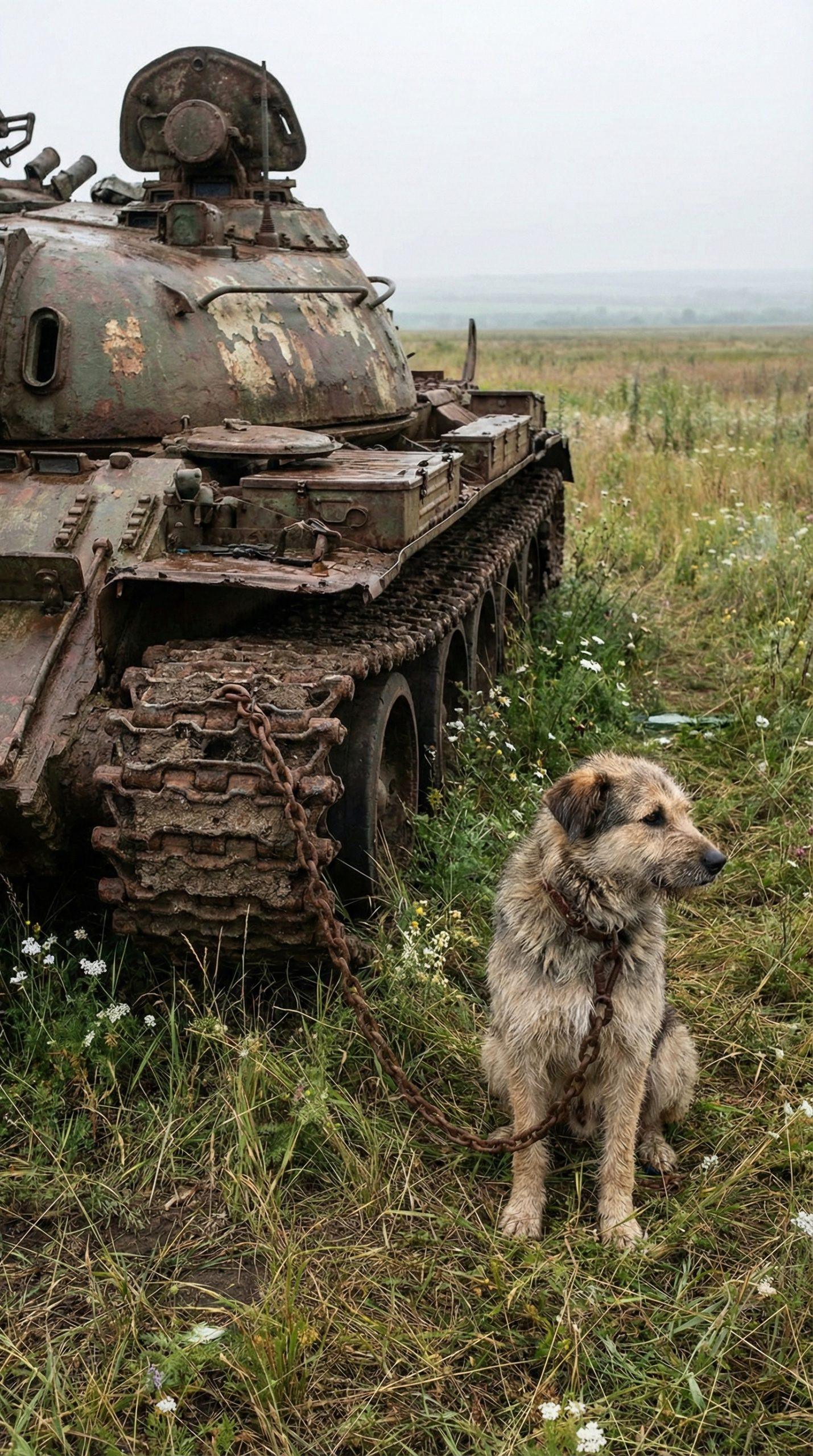
In the misty fields of eastern Ukraine, where wildflowers push through the scars of war, a photograph captured in the summer of 2025 has gone viral, stirring hearts and igniting debates worldwide. It shows a weathered, rust-eaten Soviet-era T-62 tank, its turret sagging like a defeated warrior, with a scruffy mixed-breed dog chained to its tracks. The dog, with matted fur and soulful eyes staring into the distance, appears forlorn, a symbol of neglect amid desolation. But this isn’t just a poignant snapshot of abandonment—it’s the gateway to a labyrinthine tale of international intrigue, hidden fortunes, and shocking betrayals that crisscrosses continents. What began as a simple image shared on social media has unraveled a story so bizarre, it reads like fiction, yet every twist is backed by declassified documents, eyewitness accounts, and forensic evidence. Prepare to follow the trail of this “guardian dog” and the tank it unwittingly protected, from the frozen factories of Russia to the deserts of the Middle East, the jungles of Africa, and even the corridors of power in Washington, D.C.

The story starts in the foggy outskirts of Kherson Oblast, Ukraine, in July 2025. Local farmer Oleg Petrov stumbled upon the scene while herding cattle. “I thought it was just another relic from the invasion,” Petrov recounted in an interview with BBC News. The tank, half-buried in overgrowth, had been there since Russian forces retreated in late 2022. But the dog—later named “Sentry” by rescuers—was a mystery. Chained with a heavy rusted link, it was malnourished, its ribs visible beneath tangled fur, yet it refused to leave the tank’s side, growling at anyone who approached too closely. Animal welfare volunteers from Poland, part of a cross-border aid group, eventually freed Sentry and took him to a shelter in Warsaw. Little did they know, the chain wasn’t just restraining a stray; it was locking away a secret that would expose a web of corruption involving arms dealers, rogue intelligence agents, and lost treasures from multiple wars.
Surprising twist number one: the tank wasn’t a standard battlefield casualty. Forensic analysis by Ukrainian military experts, aided by NATO advisors from Germany, revealed modifications not typical for a T-62. Hidden compartments in the hull contained traces of high-tech smuggling gear—waterproof seals, false panels, and even residue from rare earth metals. But why chain a dog to it? Initial theories pointed to a cruel prank by retreating soldiers, but deeper digging uncovered a deliberate setup. The dog was placed there as a low-tech alarm system, trained to bark at intruders, protecting something valuable inside. As investigators from Interpol’s Paris headquarters joined the probe, they discovered the tank’s serial number had been filed off, but micro-etchings traced it back to a Soviet production line in Nizhny Tagil, Russia, in 1978.
From there, the narrative leaps to Afghanistan in the 1980s. During the Soviet-Afghan War, this very tank was deployed with the 40th Army, pounding mujahideen positions in the Panjshir Valley. Eyewitnesses from Tajikistan, who served as Soviet conscripts, recall it as “The Iron Beast,” infamous for surviving multiple ambushes. But here’s the first major twist: in 1987, the tank’s commander, Captain Viktor Kuznetsov, a Russian officer with ties to the KGB, allegedly used it to smuggle opium out of Afghanistan. According to declassified CIA reports obtained through Freedom of Information Act requests in the U.S., Kuznetsov hid raw poppy resin in the tank’s ammo racks, trading it for weapons with Pakistani intermediaries across the border. The operation netted him a small fortune, but when Soviet forces withdrew in 1989, the tank was “lost” in transit—deliberately abandoned in a warehouse in Uzbekistan, where it sat for years, its hidden compartments still stuffed with contraband.
The plot thickens as we shift to the Middle East in the early 2000s. In a stunning revelation, arms trafficking records from the United Nations Office on Drugs and Crime in Vienna, Austria, show the tank resurfaced in Iraq during Saddam Hussein’s regime. Purchased on the black market through Syrian brokers, it was refurbished in a secret facility near Baghdad. Iraqi defectors now living in Jordan told Al Jazeera investigators that the tank was part of a fleet used in chemical weapons tests—its reinforced hull ideal for transporting sarin precursors. But the real shocker came from a whistleblower in Turkey: during the 2003 U.S. invasion, American special forces from the 101st Airborne Division captured the tank intact. Instead of destroying it, a corrupt contractor linked to a Halliburton subsidiary allegedly siphoned off hidden gold bars—smuggled from Afghanistan’s opium profits—that Kuznetsov had stashed inside. The gold, valued at over $2 million today, vanished into private hands, with trails leading to bank accounts in Switzerland.

Evoking deep sympathy, Sentry the dog’s role emerges as more than coincidental. Veterinary exams in Poland revealed microchips implanted in the dog, traceable to a breeding program in Kazakhstan, once part of Soviet military experiments. DNA tests, conducted by experts from the University of Edinburgh in Scotland, showed Sentry descended from a line of guard dogs used in Afghan outposts. In a heartbreaking twist, records from Russian archives in Moscow indicate that Kuznetsov’s own dog, a similar mixed breed, was left behind in Afghanistan, its offspring scattered through black market pet trades. Sentry, it turns out, was likely a direct descendant, “inherited” through generations of smuggling networks. Chained to the tank in Ukraine, he was the last unwitting sentinel of a family legacy tied to war profiteering. Animal behaviorists from Canada, consulting on the case, noted Sentry’s unusual loyalty: even after rescue, he howled at night, as if mourning the tank’s “secrets.” This detail tugged at global heartstrings, with donations pouring in from as far as Australia to fund his rehabilitation.
But the surprises don’t end there. As the investigation went global, a bombshell dropped from Africa. Ethiopian intelligence, sharing data with the African Union in Addis Ababa, linked the tank to a 2010 arms shipment to Somalia. Routed through Kenyan ports, the tank was sold to Al-Shabaab militants by a rogue Russian arms dealer—Kuznetsov’s son, who had taken over the family “business.” Hidden in the tank were not just weapons, but encrypted hard drives containing data on international money laundering. Decrypted by cybersecurity experts in Israel, the drives exposed a network involving Chinese investors funding illicit mining in the Democratic Republic of Congo. The gold from Afghanistan? It had been melted down and reinvested in conflict diamonds, cycling back to Europe via Belgian dealers in Antwerp.
The most jaw-dropping twist came from the United States. FBI agents in New York, tipped off by Ukrainian counterparts, raided a Manhattan penthouse belonging to a Wall Street financier with Russian roots. Inside, they found artifacts matching the tank’s hidden compartments: ancient Afghan coins, Iraqi antiquities looted during the chaos, and even a ledger detailing payoffs to U.S. politicians during the Iraq War. The financier, now facing extradition, claimed ignorance, but emails leaked to The New York Times revealed connections to a think tank in London, where British MI6 had allegedly turned a blind eye for “strategic intelligence.” This scandal rocked parliaments from Berlin to Ottawa, with Canadian MPs demanding inquiries into similar arms deals.
Sentry’s story, meanwhile, took a redemptive turn. Adopted by a family in Sweden, he became a therapy dog for veterans suffering from PTSD, his calm demeanor a balm for those haunted by wars in distant lands. Sympathy campaigns on platforms like GoFundMe raised over $500,000, funding animal rescues in conflict zones from Ukraine to Yemen. Yet curiosity lingers: what other secrets lie in abandoned tanks worldwide? Experts from the International Institute for Strategic Studies in London estimate thousands of such vehicles scattered across battlefields, potential time capsules of untold crimes.
This tale of a dog and a tank transcends borders, weaving through Russia, Ukraine, Afghanistan, Iraq, Syria, Pakistan, Uzbekistan, Tajikistan, Poland, Germany, France, the U.S., Jordan, Turkey, Switzerland, Kazakhstan, Scotland, Canada, Australia, Ethiopia, Somalia, Kenya, China, the Democratic Republic of Congo, Belgium, Israel, Sweden, the UK, and Yemen. It’s a reminder of how war’s shadows stretch far, binding the innocent—like Sentry—in chains of human greed. As one Ukrainian rescuer put it, “He guarded more than metal; he guarded history’s ghosts.” And in doing so, he set them free, one surprising revelation at a time.