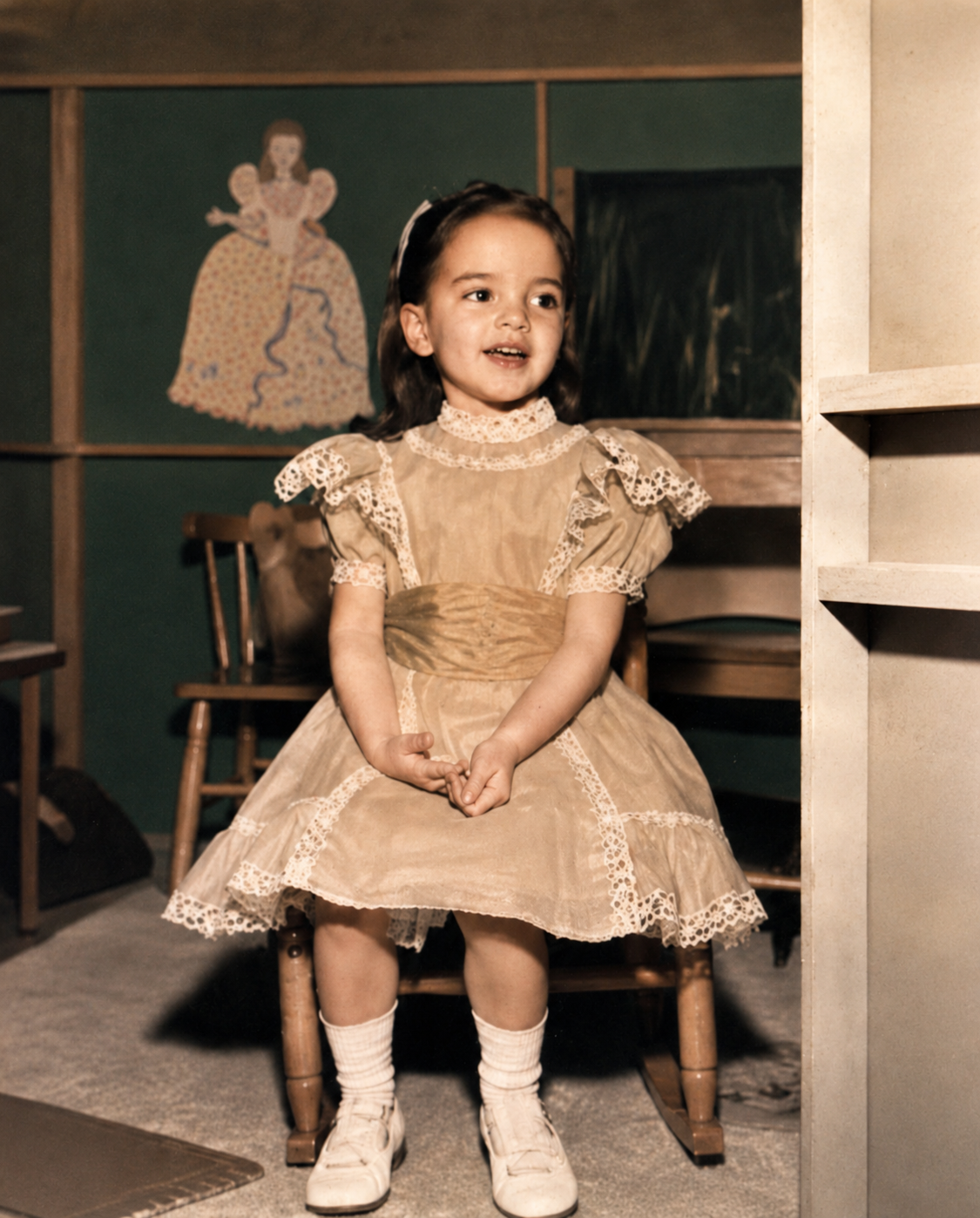
Based on the description you provided, the little girl in the black-and-white childhood photo is Liza Minnelli, one of the most distinctive performers in American entertainment history. Before the glittering stage lights, the Oscar win, the Broadway ovations, and the unmistakable voice, she was a young child growing up in one of Hollywood’s most famous families.
Liza May Minnelli was born in Los Angeles, California, to two major figures of classic Hollywood: legendary actress and singer Judy Garland and acclaimed film director Vincente Minnelli. Her childhood was anything but ordinary. While most children her age were far from movie sets and rehearsal rooms, Liza was surrounded by actors, musicians, directors, dancers, and the machinery of show business almost from birth. (Wikipedia)
Image — Young Liza Minnelli with Judy Garland, circa 1950:

Source: Wikimedia Commons

The childhood image is striking because it shows none of the bold theatrical glamour that later became Minnelli’s signature. There is no black pixie haircut, no Cabaret makeup, no spotlight, no orchestra behind her. Instead, the photo captures a small girl in a dress, holding a doll, looking bright-eyed and innocent inside a home setting. That contrast is exactly what makes the image so powerful: the child in the picture would grow into one of the most recognizable stage and screen personalities of the 20th century.
Minnelli’s first connection to film came very early. PBS notes that she appeared as a toddler in In the Good Old Summertime, the 1949 movie musical starring her mother, Judy Garland. That small appearance was only the beginning of a career that would eventually span film, television, concerts, recordings, and Broadway. (PBS)
By the 1960s, Liza began proving that she was not merely “Judy Garland’s daughter.” She moved toward the stage with serious ambition and quickly established herself as a performer with her own identity. In 1965, at only 19 years old, she won the Tony Award for Best Actress in a Musical for Flora, the Red Menace. The official Tony Awards site lists Minnelli as the 1965 winner for that role. (tonyawards.com)
That achievement mattered because it marked a turning point. Hollywood lineage may have opened doors, but it could not create the kind of stage presence Minnelli became famous for. Her performance style was intense, emotional, and physically charged. She did not simply sing a song; she attacked it, shaped it, and turned it into a dramatic event.
Then came the role that made her immortal: Sally Bowles in Bob Fosse’s 1972 film Cabaret. Set in a glamorous but politically dark world, the film gave Minnelli the perfect vehicle for her sharp theatricality, expressive face, and commanding voice. Her performance became one of cinema’s defining musical roles.
Image — Liza Minnelli as Sally Bowles in Cabaret, 1972:

Source: Wikimedia Commons

At the 45th Academy Awards, Minnelli won the Oscar for Best Actress for Cabaret. The Academy’s official record lists her as the winner in the Actress category for that film. (Oscars)
Image — Liza Minnelli publicity portrait, 1973:

Source: Wikimedia Commons

What made Minnelli different from many movie-musical stars was the way she crossed formats. She was not only a film actress. She was a Broadway performer, a concert artist, a recording artist, and a television personality. Her career built a rare bridge between old Hollywood, New York theater, nightclub performance, and modern celebrity culture.
Her awards reflect that range. Minnelli is widely recognized as an EGOT-level performer, with major honors across film, television, music, and theater. Her trophy list includes an Academy Award, Tony Awards, an Emmy, and a Grammy-related honorary recognition, placing her among a very small circle of entertainers with achievements across all four major American entertainment award fields. (Wikipedia)
Image — Liza Minnelli in 1997:

NEW YORK CITY
1997
Source: Wikimedia Commons

Still, Minnelli’s life was never just a clean success story. She lived under the shadow of enormous expectations because of her mother’s fame, while also facing the pressure of being compared to one of the most beloved performers in American history. The hidden truth often missed in nostalgic posts is that being born into a famous family can be both a privilege and a burden. It gives access, but it also removes privacy and creates lifelong comparison.
That may be why Liza Minnelli’s best performances often feel so personal. Whether she was singing, acting, or simply stepping onto a stage, she carried a sense of survival and defiance. Her image was glamorous, but her appeal was never just about glamour. It was about force, vulnerability, humor, and the ability to make an audience feel that every note mattered.
Image — Liza Minnelli at The Heart Truth Fashion Show, 2008:

Source: Wikimedia Commons

In recent years, Minnelli has made fewer public appearances, which has only increased public interest whenever she does step into the spotlight. In 2025, she appeared on the RuPaul’s Drag Race Season 17 finale, where she was honored with the show’s Giving Us Lifetime Achievement Award. People reported that the appearance celebrated her influence on drag, fashion, and LGBTQ+ culture. (People.com)
In March 2026, Minnelli also made a rare public appearance at the GLAAD Media Awards in Beverly Hills, where she received GLAAD’s first-ever storyteller award. The appearance came shortly before the scheduled release of her memoir, Kids, Wait Till You Hear This! (People.com)
That is why the childhood photo still works so well as a “guess who” image. At first glance, it looks like a simple family snapshot from old Hollywood. But behind it is the beginning of a life that would become deeply connected to Broadway, cinema, music, fame, resilience, and American pop culture.
The little girl holding a doll would grow up to command stages around the world. She would become Sally Bowles, win an Oscar, earn Broadway glory, and build a career separate from — yet forever connected to — Judy Garland’s legacy.
Today, Liza Minnelli remains more than a famous name from the past. She is a living symbol of performance itself: dramatic, imperfect, dazzling, emotional, and unforgettable.